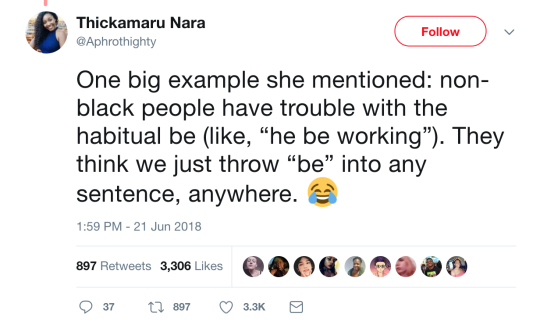
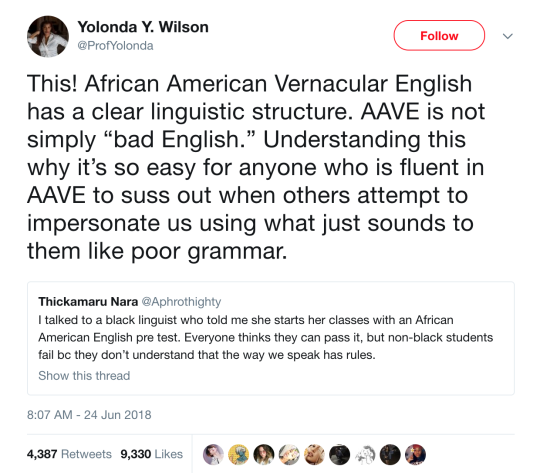
people understand that Spanish speakers speak different dialects of the Spanish language but don’t understand that black people speak a dialect of the English language
saw a variation of this conversation on twitter earlier
I just want to state for the record that this is completely uncontroversial among linguists. It’s the first day of sociolinguistics class.
The reason that AAVE is uncontroversial for linguists (academia) but controversial/debated/dismissed amongst… basically everyone else (general public) is partially because academics write papers/publish research in a way that is inaccessible to the general public, which means that academics aren’t taken seriously or are dismissed because it’s too difficult to understand.
The general public is unaware of this crucial difference, and think AAVE is just a pronunciation/accent. On the flip side, they will readily accept other dialects, also confusing it as a simple accent difference. For example: the “y’all” contraction. “Y’all” isn’t an accepted contraction in the overwhelming majority of other English-speaking countries, and is used primarily in the Southern United States. I even get the red squiggly line in my word doc when I type it! The (one of many) Southern US dialects also deviate from standard English, just like AAVE. Because that’s literally the definition of a dialect.
I don’t know enough about the racial/historical aspect of this to talk about it, but racism is certainly involved. My oversimplified (and uneducated) best guess: dismissal and unwillingness to learn because AAVE is used primarily/exclusively (?) by black people.
TL;DR:AAVE not taken seriously by non-academics/non-linguists bc they don’t know the difference between accents and dialects, and are likely dismissive and unwilling to understand AAVE as a unique dialect because it is used by black people.










 ProbablyPartyPoison