One of my favorite things about history is how little bits of it are preserved through traditions and mythology and we don’t even notice it. Like how we still say “’Tis the season” at Christmastime. Who says ‘tis anymore? No one, it’s dead except in this tiny phrase. I had a friend once tell me that she noticed the only group of people who could consistently identify a spinning wheel were girls between the ages of 4 and 7. Why? Sleeping Beauty. There are little linguistic quirks that have been around for centuries, bits of slang we use that people 400 years ago would recognize, but unless you showed someone a 400 year old dictionary, they’d never believe it. Whispers of the past are always there.
precisely! There’s far more of them than you’d realize. A pothole is from when potters used to harvest clay from the side of the road. Pot. Hole.
Your phone goes boinkey bleep but we still call it ringing, from when phones had actual bells on the outside of actual boxes.
Have you ever had to explain to a Gen Z why we “roll down” a car’s window?
Lowercase and uppercase are from typesetting, storing lead letters into boxes or cases for print.
The daily grind is from when a day’s use of grain was ground for bread.
“Fire!” as the command to shoot, in English, only picked up with gunpowder, as you’d light or fire the guns. To fire is to set fire to something. Prior to that, the command for a bunch of archers isn’t and has never been Fire, it’s Loose. Notice this little anachronism in most medievaloid films.
• Capitalization to emphasize A Word Or Phrase
• The use of ™ to show Importance™
• Commas,,, used as,,, an ellipsis,,,,
• ran dom s p aci ng to show a choked or strangled sort of tone
• Cut-offs mid sentence
• saying that they love something, or that something is doing its best, even if it’s an inanimate object
• Dramatizing every sentence (instead of saying “Oh, she’s pretty!” One would say “U would let her kill me and say thank you.”)
• random capitalization in the middle of a sentENCE TO EMPHASIZE A RISING, MORE EMOTIONAL TONE
• vague one word answers in response to a picture
• Mood/same/me
• Jokes where the only way to understand it is if you’ve seen two other vines, a tweet, and four Tumblr posts from 2012
• Noticing details about a freaky picture and acting like it’s completely normal
• The opposite: seeing a stupid picture and losing it in response
If anyone wants to follow a twitter account that shitposts about linguistics in the style of dril, follow /dɹɪl/ at lingwintstics and you’ll be blessed with tweets like
THIS IS SO COOL. Like I knew that it was a thing, I just didn’t realize it was such a UNIQUE THING.
we actually have more than one, depending on the variety of english you speak! they mostly tend to be profanity for example, in australian and british english, another infix is “bloody” abso-bloody-lutely, mate
also, in hip hop slang, we have “iz” or “izn” like, shiznit for shit and “ma”, “whose location in the gives a word an ironic pseudo-sophistication, as insophistimacated, saxomaphone, and edumacation”
I started looking into this after reading several fics featuring Taako where his speaking voice was…kind of jarring to me? Mainly in the usage of vocatives. Taako uses vocatives (my dude, homie, darling etc) but he uses them in particular ways, and they’re often very overused when people write dialogue for Taako.
Anyway, as I started researching this, it felt a little…mean-spirited? so I stopped lol. but the more I thought about it, the more I was interested in these particular quirks of Taako’s speech and how they add to his character. A bunch of you seemed interested in it too. So here I present the essay nobody asked for but some wanted after I mentioned it: Hot Linguistic Take on Taako’s Speech! Under a readmore cuz it got LONG, y’all. Buckle up.
i just wanted to respond to another thing lots of people have mentioned! i don’t think justin did this super intentionally. meaning, i don’t think he was consciously doing it? like, that’s the really cool thing about linguistics in general. i think this is something justin did subconsciously, using taako’s speech to deflect and create distance, and dropping that guard with people he trusted. (i think that’s something lots of us do in our regular speech! and maybe it’s something justin does too?)
anyway, i wasn’t trying to say this was like, something justin had fully thought out or planned. it developed naturally with taako’s character and i think that’s super cool.
Want to teach yourself linguistics on youtube? Looking for online courses about linguistics? Want to supplement the linguistics resources available for your linguistics class? Here’s an extensive list for you to pick from, with a few notes on style and content.
The Linguistic Society of America’s youtube channel has both public lectures from prominent linguists (tend to assume some background knowledge of linguistics) and some recordings of professional development webinars, such as how to write an abstract
The Five Minute Linguist talks: 2017 and 2018 (one long video of many short, engaging talks about linguistics)
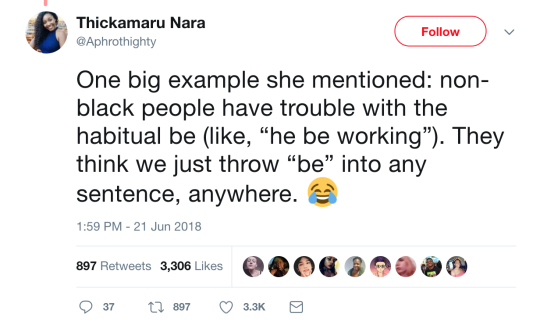
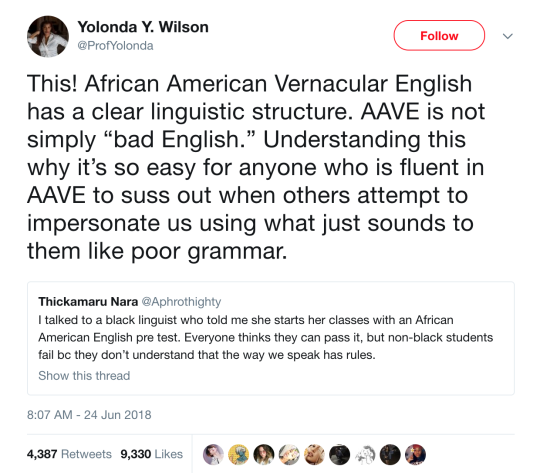
people understand that Spanish speakers speak different dialects of the Spanish language but don’t understand that black people speak a dialect of the English language
saw a variation of this conversation on twitter earlier
I just want to state for the record that this is completely uncontroversial among linguists. It’s the first day of sociolinguistics class.
The reason that AAVE is uncontroversial for linguists (academia) but controversial/debated/dismissed amongst… basically everyone else (general public) is partially because academics write papers/publish research in a way that is inaccessible to the general public, which means that academics aren’t taken seriously or are dismissed because it’s too difficult to understand.
The general public is unaware of this crucial difference, and think AAVE is just a pronunciation/accent. On the flip side, they will readily accept other dialects, also confusing it as a simple accent difference. For example: the “y’all” contraction. “Y’all” isn’t an accepted contraction in the overwhelming majority of other English-speaking countries, and is used primarily in the Southern United States. I even get the red squiggly line in my word doc when I type it! The (one of many) Southern US dialects also deviate from standard English, just like AAVE. Because that’s literally the definition of a dialect.
I don’t know enough about the racial/historical aspect of this to talk about it, but racism is certainly involved. My oversimplified (and uneducated) best guess: dismissal and unwillingness to learn because AAVE is used primarily/exclusively (?) by black people.
TL;DR:AAVE not taken seriously by non-academics/non-linguists bc they don’t know the difference between accents and dialects, and are likely dismissive and unwilling to understand AAVE as a unique dialect because it is used by black people.


 ProbablyPartyPoison